

Most people believe they understand their constitutional rights during a police encounter. After all, television shows, movies, and viral social media clips have spent decades shaping public perception about criminal investigations and arrests.
The problem is that much of what people think they know is either incomplete or flat-out wrong.
Misunderstanding your legal rights during a police encounter can have serious consequences. In some situations, a simple mistake or misunderstanding can unintentionally make matters worse.
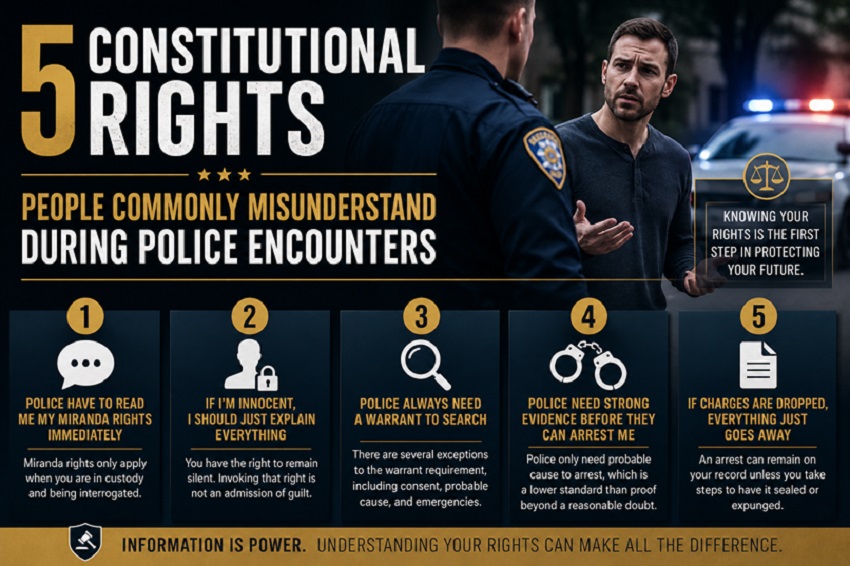
Here are five constitutional rights that people commonly misunderstand—and what the law actually says.
1. “Police Have to Read Me My Miranda Rights Immediately”
This is perhaps the most common misconception about criminal law.
Many people believe police are required to read Miranda warnings the moment handcuffs go on. If officers fail to do so, people assume the case automatically gets dismissed.
That is not how it works.
Miranda rights—commonly known as the right to remain silent and the right to an attorney—generally become necessary only when two things occur:
- A person is in custody, and
- Police are conducting interrogation or questioning likely to elicit an incriminating response.
In other words, officers do not necessarily need to read Miranda rights during a traffic stop, casual interaction, or immediately after an arrest.
What usually happens if Miranda is violated is not automatic dismissal. Instead, statements obtained in violation of Miranda may potentially be excluded from evidence.
The distinction matters.
2. “If I’m Innocent, I Should Just Explain Everything”
Many innocent people believe that cooperating fully and answering every question will clear things up.
Sometimes that instinct can backfire.
The Fifth Amendment right against self-incrimination exists for a reason. Even innocent people can become nervous, confused, inconsistent, or misunderstood during police questioning.
Small discrepancies in a story may later be portrayed as dishonesty. Statements made without full context can be misinterpreted.
Importantly, invoking the right to remain silent is not an admission of guilt.
Courts routinely recognize that people have a constitutional right not to answer investigative questions. Exercising that right should not automatically be viewed as suspicious.
A respectful statement such as, “I would like to speak with an attorney before answering questions,” is often far wiser than attempting to talk your way out of a stressful situation.
3. “Police Always Need a Warrant to Search”
Many people believe officers cannot search anything without first obtaining a warrant signed by a judge.
The reality is more complicated.
While the Fourth Amendment protects against unreasonable searches and seizures, there are several well-established exceptions to the warrant requirement.
For example, searches may sometimes occur when:
- A person gives consent
- Evidence is in plain view
- Officers have probable cause involving a vehicle
- There are exigent circumstances, such as emergencies
- A search occurs incident to an arrest
One of the biggest mistakes people make is voluntarily consenting to a search without realizing they have the ability to refuse in some circumstances.
Simply saying, “I don’t consent to any searches,” can preserve important legal arguments later.
That said, people should remain calm and never physically interfere with officers, even if they believe a search is improper.
4. “Police Need Strong Evidence Before They Can Arrest Me”
Many people assume police must possess overwhelming proof before making an arrest.
In reality, the legal standard for arrest is usually probable cause, which is much lower than proof beyond a reasonable doubt.
Probable cause generally means officers have sufficient facts and circumstances to reasonably believe a crime occurred and that a particular person committed it.
That does not mean prosecutors can ultimately prove guilt at trial.
This distinction is important because some people wrongly assume an arrest automatically means the government has a strong case. In many situations, evidence may later be challenged, contradicted, or excluded.
An arrest is the beginning of the legal process—not the final outcome.
5. “If Charges Are Dropped, Everything Just Goes Away”
Another common misunderstanding is that dismissed charges automatically disappear from a person’s record.
Unfortunately, arrests often remain visible unless additional legal action is taken.
Depending on state law and case circumstances, people may need to pursue options such as:
- Record sealing
- Expungement
- Court petitions to limit public access
Without taking those extra steps, dismissed or dropped charges may still appear during background checks, housing applications, or employment screenings.
For many people, protecting their future means understanding that a favorable case outcome does not always automatically erase the past.
Final Thoughts
Police encounters can be stressful, fast-moving, and intimidating. Unfortunately, misinformation about constitutional rights often causes people to make decisions they later regret.
Knowing the difference between legal myths and reality matters.
The Constitution provides important protections, but those protections are most useful when people actually understand how they work in real-world situations.
Understanding when to speak, when to remain silent, and how constitutional rights apply can make a significant difference when facing police scrutiny or a criminal investigation.


